Empowering Businesses in Nepal with All-in-One Solutions
Find out the first daily deals available for you
<p>Shanti learned tailoring soon after completing grade 10. For almost 15 years she worked for others and when she delivered her first baby she decided to quit working for others and get advanced training in tailoring. While getting the training, a plastic-free community campaign had started in her locality which led her to stitch cloth bags (Tote bags) for grocery purposes which she was able to sell in huge quantities. This gave her the needed encouragement to continue with her tailoring business.</p>
<p>Some 9 years ago, Sajani was looking for income-generating opportunities when her friend suggested that she join a yomari making training session. After the training she was connected to the Village cafe by SABAH and her financial independence journey is going well. She is happy that with the skill of making yomaris with different fillings in it she can offer traditional food with a twist to her customers. She proudly shares that she can generate enough income now and doesn’t ask for money from her husband for her expenses. Life became much easier when both (she and her husband) took care of family finances.</p>
<p>Neha proudly calls herself a farmer. She is into agriculture and loves growing organic produce. She not only sells her products but also procures local spices, package them well, and offers them to her customers. While she has been farming for a long time, she has been running a store for three years now. She also sells various products through farmers’ markets. She likes to support fellow women agri- entrepreneurs to enhance the agriculture sector and promote organic products for better health.</p>
<p>Rabita makes varieties of bags and masks. She used to knit and has experience in knitting for more than 15 years. She wanted to try something new. Rabita had a very limited stitching skill set and therefore she was very excited when she got the opportunity to attend the training on tailoring. It was just before the pandemic hit the world that Rabita got the skill development training on making bags and masks. She enjoys doing it as things help her to be creative and bring out varieties of products to serve the customers.</p>
<p>Sabina learned to stitch clothes from her mother and she equally enjoys knitting as well. She worked for a boutique store for some time and then took formal training on tailoring. After taking training she took this profession seriously and has been doing it for 10 years now. She is happy that because of her skill, she can earn income from home. She realizes that to grow her business, she has to invest more and reach out to a larger market.</p>
<p>Saran Maya remembers the time when she was working in a carpet factory. She used to laboriously make carpets and was looking for a change. One day, her friend suggested that she join a yomari making training session along with her. Saran Maya shared that her husband supported her with household chores while she was taking the training. It's been seven years now that she has been making yomari and momos sold in Village Cafe by Sabah. She is extremely happy that she decided to consider her friend’s suggestion of learning yomari making which has currently helped her have a good income source.</p>
<p>Nirmala has been involved in agriculture for more than 20 years. She eventually realized that she could get into the agri business and has been doing so for 7 years now. She grows various agri products which tend to be seasonal while lapsi (Hog plum) candies once made can last longer, that is why most of her income comes from lapsi candies business. She is confident that if she gets proper market linkage her business will definitely get to the next level. She also actively volunteers in community development work and encourages women to use their skills to generate income. Nirmala lives in a joint family of twenty-one members.&nbsp;</p>
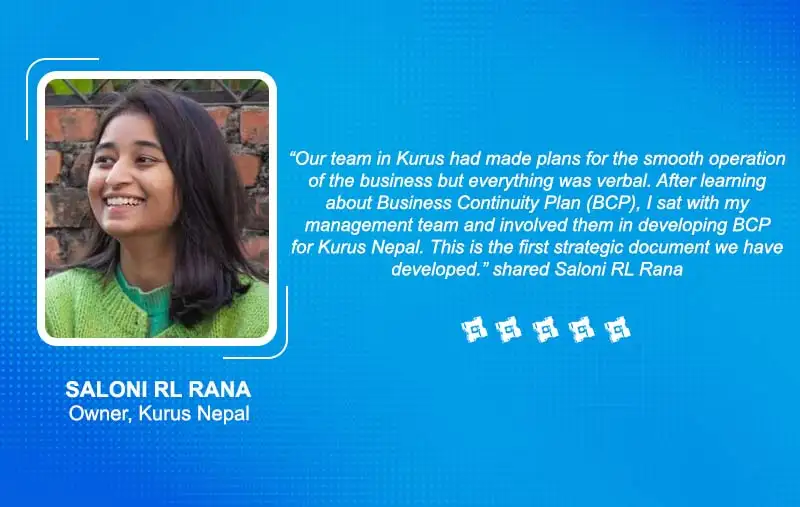
<p>Young and very much environmentally conscious, Saloni has built an enterprise keeping climate change in her mind. While many youngsters at her age are focusing on their own salaried career, Saloni made a choice to be an entrepreneur and provide income-generating opportunities to others. Through Kurus Nepal she offers environmentally friendly yarn and wool products crafted by women. She shares that initially she and her friends were running a nonprofit organization and realized soon that in order to sustain for a long run they have to switch to a revenue-generating model. That is how Kurus Nepal came into existence. Kurus Nepal products are made of natural and environmentally friendly raw materials. Natural materials are used for the packaging of products instead of plastic or nonbiodegradable materials. Saloni is an inspiration to all the generations who are looking to start something innovative.</p>
<p>Ganga has been involved in the tailoring business since 2013. Initially she had taken training on tailoring in order to make clothes for her infant but gradually her interest grew and she took this profession seriously. She likes to make new clothes for people and tries out different designs. She believes clothes play a huge role in enhancing an individual’s personality and she feels happy to be able to contribute to building confidence in people through her clothes. She makes clothes for kids and adults both. She would like to take more courses on fashion designing and grow her business.</p>
<p>Rupkamal is very enthusiastic about her tailoring business. She has been into this business for 10 years now and is still passionate about it. She shares that people come with various designs and ask to make a similar dress for them. When the design is new Rupkamal feels a little skeptical but when she gets to the end result the moment makes her proud of herself. She knows the value of her skill and therefore she wants to transfer her skills to many other individuals who want to take up tailoring as their career. She realizes that her skill can create job opportunities for others as well.</p>
<p>Bimala is an agro entrepreneur based in Kavre. She shares that agriculture has always been a part of life, it comes naturally. The land is fertile and there is so much more one can do in the agriculture sector in Nepal, believes Bimala. Her main products are varieties of vegetables and Lapsi Candies. She rejoices when people enjoy the lapsi candies made by her. Bimala feels that proper packaging and marketing of products will provide a lot of business opportunities. She lives with her husband and two children. Having an entrepreneurial mindset, Bimala is intending to get her hands into diverse businesses as well.</p>
<p>Machhindra runs a small store where she sells self-grown produce like vegetables, grains, and gundruk. She likes to call herself an agri-business person. It is very difficult to compete in a market where people get to choose from various imported products available. On the other hand, local farmers are decreasing day by day. Machhindra shares that she plans to continue farming as this is what she is good at. She has her regular customers and buys her products only. Locals out there have known her for a long time and have seen her work hard and, hence, show their support through purchasing her products. With time, competition has grown and she wishes to compete well and therefore is looking to grow her business more.</p>
<p>Laxmi has been in the tailoring business for 16 years now. She completed her 10th grade and started working in a tailoring shop. Something she opted for earning pocket money turned into her full-time profession. She later completed her high school studies, worked in a tailoring shop for three years, and got ready to start her own tailoring business, independently. She started stitching dresses and clothes from her home in the beginning and then rented out a store. Looking, back she feels she has come a long way; she not only stitches clothes but also provides training on tailoring.&nbsp;</p>
<p>Khema Devi shares, ‘It is very hard to be a woman in this unfair world. One can fight with people but how can one fight with fate’. Khema Devi is definitely a wonder woman and a strong mother every child would look up to. Been married at the age of 16 and lost her husband within four years, she &nbsp;is a single mother to her only son. Initially, the challenge was to be emotionally strong, financially independent to look after her son. She started with tailoring and slowly tried her hands at different businesses. Currently she runs a business of herbal supplements and hygiene products. According to Khema, these products are very effective as she is also one of the consumers. Therefore, it has become easier to market the product in the community she lives in. Having a regular source of income through her business, Khema is not only supporting her son but also advancing her education. With pride Khema shares that she has joined high school and will graduate&nbsp;soon.&nbsp;</p>
<p>Making lapsi candies for her family and friends was something she rejoiced. People encouraged her to start her own lapsi candy business. While she was hesitant initially, Devaka decided to take a plunge into entrepreneurship. Although she started Champak Pau Udhyog on a small scale catering to people she knew personally, her business started to flourish and is now catering to the masses. &nbsp;Champak Pau Udhyog has a variety of lapsi candies and nepali sweet, sour spicy pau and other snack items. Devaka shares that she feels nostalgic when she looks back at the time when she started. Her joy gets to the next level when people share their love for her lapsi candies. &nbsp;Devaka lives in a family of 8 members and is one of the breadwinners.&nbsp;</p>
<p>Oliin Rai manages a social enterprise “Higher Ground Nepal '' which produces bags, home-decor items, jewelries, cards, bakery items and accessories from the available local resources. She is very passionate about the work she does at Higher Ground. She has been working for 10 years now and with each passing year she is proud to be able to create an impact in the society by creating jobs for marginalized groups who make the products and hence helping them to live a dignified life. Oliin shares that her business is focused on creating a social impact while making profits. Oliin lives with her extended family of eight where she happily contributes financially as well as emotionally.</p>
<p>Urmila Chaudhary is a happy soul, who until now lived for her family and kids. While now that her kids are adults and can look after themselves, Urmila has decided to start her second inning. A year back she took skill based training on weaving baskets (Dhakiya). She shares that, “If only I had learned it from my mom I didn’t have to prick my brains to learn the basics at this age.” She chose to learn this particular kind of basket weaving skill as this defines her culture. She wants to take forward the Dhakiya making tradition so that she contributes in preserving one of the Tharu cultures. Making Dhakiyas at her home since the training, Urmila is in the process of registering her business.</p>